
Designing traceable opioid material§ kits to improve laboratory testing during the U.S. opioid overdose crisis.
Authors of this article are:
Mojica MA, Carter MD, Isenberg SL, Pirkle JL, Hamelin EI, Shaner RL, Seymour C, Sheppard CI, Baldwin GT, Johnson RC.
A summary of the article is shown below:
In 2017, the U.S. Department of Health and Human Services and the White House declared a public health emergency to address the opioid crisis (Hargan, 2017). On average, 192 Americans died from drug overdoses each day in 2017; 130 (67%) of those died specifically because of opioids (Scholl et al., 2019). Since 2013, there have been significant increases in overdose deaths involving synthetic opioids – particularly those involving illicitly-manufactured fentanyl. The U.S. Drug Enforcement Administration (DEA) estimates that 75% of all opioid identifications are illicit fentanyls (DEA, 2018b). Laboratories are routinely asked to confirm which fentanyl or other opioids are involved in an overdose or encountered by first responders. It is critical to identify and classify the types of drugs involved in an overdose, how often they are involved, and how that involvement may change over time. Health care providers, public health professionals, and law enforcement officers need to know which opioids are in use to treat, monitor, and investigate fatal and non-fatal overdoses. By knowing which drugs are present, appropriate prevention and response activities can be implemented. Laboratory testing is available for clinically used and widely recognized opioids. However, there has been a rapid expansion in new illicit opioids, particularly fentanyl analogs that may not be addressed by current laboratory capabilities. In order to test for these new opioids, laboratories require reference standards for the large number of possible fentanyls. To address this need, the Centers for Disease Control and Prevention (CDC) developed the Traceable Opioid Material§ Kits product line, which provides over 150 opioid reference standards, including over 100 fentanyl analogs. These kits were designed to dramatically increase laboratory capability to confirm which opioids are on the streets and causing deaths. The kits are free to U.S based laboratories in the public, private, clinical, law enforcement, research, and public health domains.Published by Elsevier B.V.
Check out the article’s website on Pubmed for more information:
[link-preview url=https://www.ncbi.nlm.nih.gov/pubmed/31560942 forceshot=true]
This article is a good source of information and a good way to become familiar with topics such as: Analgesics, Opioid; Calibration; Drug Overdose; Fentanyl; Humans; Opioid-Related Disorders; Predictive Value of Tests; Reagent Kits, Diagnostic; Reference Standards; Reproducibility of Results; Substance Abuse Detection; United States.
NativeFolder: The Only Bacterial Culture Medium for the Expression of Soluble Proteins
-
- Sale!
- Molecular Biology, Research Kits
NativeFolder Bacterial Culture Medium
- Original price was: $795.00.$295.00Current price is: $295.00.

Interference Test Kit for Assay Validation
-
- Sale!
- Interference, Research Kits
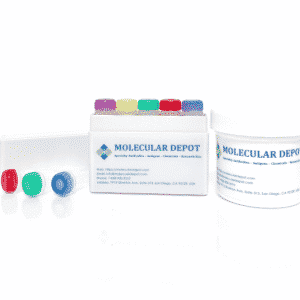
Interference Test Kit
- Original price was: $995.00.$495.00Current price is: $495.00.

Rheumatoid Factor Interference Blocker
-
- Sale!
- Antibodies, Interference
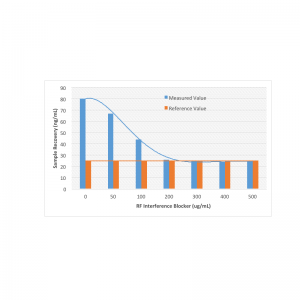
Rheumatoid Factor Interference Blocker
- Original price was: $595.00.$395.00Current price is: $395.00.

New Antibodies from MOLECULAR DEPOT
-
- Sale!
- Antibodies
Zebrafish wnt8b Antibody (Center)
- Original price was: $1,295.00.$695.00Current price is: $695.00.
-
- Sale!
- Antibodies
TRIB2 Antibody (N-Term)
- Original price was: $1,295.00.$695.00Current price is: $695.00.
-
- Sale!
- Antibodies
NTN1 Antibody (C-Term)
- Original price was: $1,295.00.$695.00Current price is: $695.00.
-
- Sale!
- Antibodies
NME1 Antibody
- Original price was: $1,295.00.$695.00Current price is: $695.00.
-
- Sale!
- Antibodies
Parp9 Antibody (C-Term)
- Original price was: $1,295.00.$695.00Current price is: $695.00.
-
- Sale!
- Antibodies
CDK1 Antibody
- Original price was: $1,295.00.$695.00Current price is: $695.00.
-
- Sale!
- Antibodies
DANRE hoxc11a Antibody (N-Term)
- Original price was: $1,295.00.$695.00Current price is: $695.00.
-
- Sale!
- Antibodies
VDR Antibody (Center)
- Original price was: $1,295.00.$695.00Current price is: $695.00.
-
- Sale!
- Antibodies
ITIH4 Antibody (C-Term)
- Original price was: $1,295.00.$695.00Current price is: $695.00.
-
- Sale!
- Antibodies
SEMA4B Antibody (C-Term)
- Original price was: $1,295.00.$695.00Current price is: $695.00.

New Proteins from MOLECULAR DEPOT
-
- Sale!
- Conjugates, Proteins
Captopril HSA Biotin Conjugate
- Original price was: $1,995.00.$995.00Current price is: $995.00.
-
- Sale!
- Proteins
PKC-α, Active, GST-tagged from Xanopus sp.
- Original price was: $1,595.00.$795.00Current price is: $795.00.
-
- Sale!
- Conjugates, Proteins
Prilocain BSA Biotin Conjugate
- Original price was: $1,995.00.$995.00Current price is: $995.00.
-
- Sale!
- Conjugates, Proteins
T3 (Triiodothyronine) BSA Biotin Conjugate
- Original price was: $1,995.00.$995.00Current price is: $995.00.
-
- Sale!
- Conjugates, Proteins
Pipemidic Acid BSA Biotin Conjugate
- Original price was: $1,995.00.$995.00Current price is: $995.00.
-
- Sale!
- Proteins
PKD2 Protein, Active (Recombinant Human)
- Original price was: $1,795.00.$895.00Current price is: $895.00.
-
- Sale!
- Conjugates, Proteins
Meropenem BSA Biotin Conjugate
- Original price was: $1,995.00.$995.00Current price is: $995.00.
-
- Sale!
- Conjugates, Proteins
Piperacillin BSA Biotin Conjugate
- Original price was: $1,995.00.$995.00Current price is: $995.00.
-
- Sale!
- Proteins
Protein A Peroxidase from Staphylococcus aureus/horseradish
- Original price was: $1,195.00.$595.00Current price is: $595.00.
-
- Sale!
- Conjugates, Proteins
Tobramycin BSA Biotin Conjugate
- Original price was: $1,995.00.$995.00Current price is: $995.00.

New Chemicals from MOLECULAR DEPOT
-
- Sale!
- Chemicals, Interference, Lipids
Triglyceride Mix for Interference Testing
- Original price was: $895.00.$395.00Current price is: $395.00.
-
- Sale!
- Chemicals
Microparticle Stabilizer Solution
- Price range: $295.00 through $495.00
-
- Sale!
- Buffers & Solutions, Chemicals
Enzyme Acceptor Stabilization Buffer
- Original price was: $495.00.$250.00Current price is: $250.00.
-
- Sale!
- Buffers & Solutions, Chemicals
Enzyme Donor Stabilization Buffer
- Original price was: $495.00.$250.00Current price is: $250.00.
-
- Sale!
- Chemicals, Conjugates
Progesterone Biotin Conjugate Solution
- Original price was: $995.00.$595.00Current price is: $595.00.
-
- Sale!
- Buffers & Solutions, Chemicals
Microparticle Activation Buffer
- Price range: $395.00 through $695.00
-
- Sale!
- Buffers & Solutions, Chemicals
Microparticle Washing Buffer
- Price range: $395.00 through $695.00
-
- Sale!
- Buffers & Solutions, Chemicals
Microparticle Blocking Buffer
- Price range: $395.00 through $695.00
-
- Sale!
- Buffers & Solutions, Chemicals
Latex Microparticles Anti Aggregation Agent
- Price range: $295.00 through $3,500.00
-
- Sale!
- Chemicals
CPRG (Chlorophenol red-β-D-galactopyranoside)
- Original price was: $850.00.$395.00Current price is: $395.00.